When people decide it’s finally time to see a therapist, one of the first hurdles they hit is alphabet soup. The therapist directory looks like a Scrabble board — LCSW, LMFT, LPC, LCPC, PsyD, PhD, LCAT… and it just keeps going.
Two of the most common — and most confusing — titles are LCSW and LMFT.
At a quick glance, both licenses look almost identical. Both can diagnose mental health disorders. Both can provide therapy. Both can work with individuals and families. And both can help you unpack anxiety, trauma, depression, and the life chaos that keeps punching you in the gut.
But their training, worldview, and therapeutic lens are very different.
It’s a bit like comparing a general physician to a cardiologist. Both treat you, but each one looks at your symptoms through a different lens.
What Is an LCSW?
An LCSW (Licensed Clinical Social Worker) comes from the social work world, which is rooted in understanding people in the context of their environment.
If life is a puzzle, an LCSW doesn’t just look at one piece. They pour the whole box on the table.
They ask questions that many other mental health providers forget to ask:
- “How is your housing situation?”
- “Are you having trouble at work?”
- “Is childcare stressing you out?”
- “What life events shaped this problem?”
- “Do you have support around you?”
This doesn’t mean they ignore clinical needs. LCSWs perform full mental health assessments, diagnose psychiatric conditions, run therapy sessions, and coordinate long-term treatment.
But their superpower lies in understanding the human + environment interaction.
Here’s what LCSWs receive specialized training in:
- Clinical psychotherapy
- Trauma-responsive care
- Mental health evaluations
- Crisis intervention
- Social systems (housing, schooling, employment, welfare)
- Healthcare integration
- Advocacy
- Case management
- Connecting people to community resources
If someone’s depression is tied to a toxic job, an LCSW is the type of clinician who’ll say:
“Okay, let’s treat the depression — but let’s also talk about whether the job itself is harming you.”
They treat the person and the surrounding factors squeezing the person.
What Is an LMFT?
An LMFT (Licensed Marriage and Family Therapist) trains under a completely different model — one that sees emotional struggles as part of a system.
Family system. Relationship system. Communication system.
Patterns, cycles, roles — all the invisible threads between people.
An LMFT wants to know:
- “How does your partner react when you shut down?”
- “What role did you play growing up?”
- “What communication habits did you learn from your parents?”
- “Is this argument about dishes… or something you’ve been carrying for 10 years?”
Where an LCSW zooms out, an LMFT zooms in — especially on the patterns between you and others.
Their training typically centers around:
- Couples counseling
- Marriage therapy
- Family conflict
- Relationship communication
- Emotionally focused therapy
- Attachment theory
- Family systems theory
- Relational trauma
- Repeating generational patterns
LMFTs are the therapists people turn to when life feels like a soap opera — full of tangled emotions, recurring arguments, old wounds, and family drama that won’t go away.
They’re not just therapists. They’re relationship translators.
Education Paths: How Each One Gets Licensed
Even though both end up as mental health clinicians, their academic roads look different.
LCSW Education Path
- A bachelor’s degree (any major)
- Master of Social Work (MSW)
- 2,000–4,000 supervised clinical hours
- A state licensing exam
- Ongoing continuing education every 1–2 years
During the MSW, students take courses like:
- Clinical diagnosis
- Trauma treatment
- Psychotherapy
- Human behavior
- Social policy
- Child welfare
- Substance abuse
- Medical social work
They learn how mental health intersects with poverty, gender, race, family dynamics, systemic inequality, and healthcare challenges.
LMFT Education Path
- A bachelor’s degree
- Master’s in Marriage & Family Therapy
(or a counseling degree with an MFT concentration) - 2,000–4,000 supervised clinical hours
- State licensing exam
Their coursework dives deep into:
- Couples therapy
- Family counseling
- Human sexuality
- Relationship dynamics
- Attachment
- Parenting systems
- Communication theory
- Conflict resolution
Both paths are rigorous, but LMFT programs are more specialized from day one.
Treatment Style: How Each Clinician Works
This is where the biggest difference shows up — in the therapy room.
LCSW Therapy Style
An LCSW tends to:
- Explore emotional patterns
- Identify environmental triggers
- Create practical coping strategies
- Help with community resources
- Address the impact of trauma
- Provide long-term therapy
- Support the client holistically
You walk in saying, “I’m stressed all the time,” and an LCSW might help you unpack:
- workplace burnout
- financial pressure
- old trauma
- relationship problems
- low self-esteem
- sleep issues
- parenting stress
Their lens is broad.
LMFT Therapy Style
An LMFT tends to:
- Look at relationship cycles
- Spotlight communication breakdowns
- Identify family patterns shaping the issue
- Focus on emotional attachment
- Work with couples or families in the same session
You walk in saying, “We keep fighting,” and an LMFT helps you unpack:
- triggered attachment patterns
- unresolved resentment
- communication blocks
- family-of-origin learning
- how each partner contributes to the cycle
If therapy feels like detective work, LMFTs investigate relationships while LCSWs investigate life as a whole.
Where They Work: Settings & Typical Roles
Because their training differs, their workplaces do too.
LCSWs Work In:
- Hospitals
- Psychiatric units
- Rehab facilities
- Schools
- Government agencies
- Homeless shelters
- Child welfare
- Corporations
- Hospice and palliative care
- Community health clinics
- Private practice
They’re built for environments that require clinical therapy plus resource navigation.
LMFTs Work In:
- Private practice
- Marriage counseling centers
- Behavioral health clinics
- Schools
- Youth counseling agencies
- Telehealth platforms
LMFTs gravitate toward therapy-focused settings — especially private practice.
Salary Differences: Who earns more?
The numbers vary by state, but here’s the national snapshot:
LCSW Salary Range
- $68,000 – $90,000
Hospitals pay more. Social service agencies pay less.
Private practice can match LMFT income.
LMFT Salary Range
- $60,000 – $82,000
The highest earning LMFTs are usually in private practice, especially those specializing in: - couples therapy
- affair recovery
- premarital counseling
- sex therapy
Cash-pay couples therapy often boosts LMFT income beyond their average salary.
Which License Has More Flexibility?
If flexibility matters, LCSW clearly wins.
An LCSW can pivot into:
- medical social work
- private practice
- crisis work
- school counseling
- corporate wellness
- government agencies
- mental health clinics
- advocacy
But if your passion is specifically relationships, LMFT is the more direct path.
Insurance Credentialing: Who Gets Accepted More Easily?
Insurance companies don’t treat LCSWs and LMFTs the same.
Some are equal. Others show favoritism (and yes, it’s obvious).
LCSWs Have the Easiest Path
LCSWs are widely recognized across all states and nearly all payer types.
They can credential with:
- Medicare
- Medicaid
- Private insurance
- Commercial payers
- EAP programs
- Managed care
- HMOs / PPOs
An LCSW is like the “default setting” for mental health credentialing.
If a payer only panels one type of therapist, it’s usually LCSW.
LMFTs Have More Restrictions
LMFT credentialing rules vary state by state.
Common problems LMFTs face:
- Some Medicaid plans do not credential LMFTs at all.
- Some states allow LMFT credentialing only under certain contract types.
- Some insurers restrict LMFTs in hospital or medical billing settings.
- Some payers accept LMFTs for behavioral health but NOT for integrated care.
Example states where LMFTs face limitations:
- Texas (Medicaid restrictions)
- Florida (varies by region)
- Georgia (some insurers don’t panel LMFTs)
- Michigan (historically limited, improving now)
LCSWs rarely face these barriers.
Medicare vs LMFT/LCSW: BIG Changes
LCSWs Have Full Medicare Recognition
LCSWs can:
- Credential with Medicare
- Bill Medicare directly
- Offer telehealth to Medicare patients
- Treat patients in hospitals, SNFs, home health, hospice
And they get paid as fully recognized mental health clinicians.
LMFTs — Medicare Recognition Began in 2024
Before 2024, LMFTs couldn’t bill Medicare at all.
Now they can, but:
- Implementation varies by region
- Some MACs (Medicare Administrative Contractors) take months to complete enrollment
- Provider numbers get delayed
- Reimbursement still isn’t identical to LCSWs (slightly lower in some regions)
Medicare is catching up, but LCSWs remain the gold standard in medical settings.
Reimbursement Rates: Who Gets Paid More?
Let’s talk money — because reimbursement determines your sustainability as a provider.
Most commercial payers set identical or near-identical rates for:
- LCSW
- LMFT
- LPC
- LCPC
- Psychologists (except PhD/PsyD, who earn more)
But in reality, there are nuanced differences.
These are hypothetical averages to help you visualize the gap:
| Code | LCSW Avg | LMFT Avg | Notes |
| 90791 (Psych diagnostic eval) | $130–$165 | $115–$150 | LCSWs often get +5% to +10% |
| 90834 (45-min therapy) | $85–$115 | $80–$110 | Usually similar |
| 90837 (60-min therapy) | $95–$140 | $90–$135 | Slight gap in some states |
| 90846/90847 (Family/couples therapy) | $100–$130 | $100–$140 | LMFTs sometimes earn MORE for couples/family |
| H codes (Medicaid) | $55–$90 | $45–$75 | LCSWs win here |
Key takeaway:
- LCSWs earn slightly more across MOST codes.
- LMFTs sometimes earn more for family/marriage codes.
Billing Scope: Who Can Bill What?
Both LCSWs and LMFTs can bill the same core CPT codes, including:
- 90791 — Psych diagnostic eval
- 90832 — 30-min therapy
- 90834 — 45-min therapy
- 90837 — 60-min therapy
- 90846/90847 — Family therapy
- 90839/90840 — Crisis psychotherapy
- 96127 — Depression screening (if payer allows)
- T1016/H0032 (Medicaid-specific codes, state dependent)
But here’s where the difference kicks in:
LCSWs Can Bill Medical-Integrated Codes
Because LCSWs are recognized in medical settings, they can often bill:
- Hospital-based mental health services
- SNF mental health visits
- Hospice psychosocial care
- Home health mental health services
- FQHC/RHC services
- Collaborative care (CoCM codes: 99492–99494)
- Health behavior codes (in some states)
LMFTs typically cannot bill these unless:
- A state allows
- A payer specifically contracts them
- They’re under a group contract
LCSWs get more billing pathways.
Medicaid Billing Differences (Biggest Real-World Gap)
Medicaid = the biggest problem area for LMFTs.
LCSWs → Fully recognized
They can bill:
- Outpatient therapy codes
- Case management codes
- Crisis intervention
- Telehealth
- Substance use disorder programs
- Child welfare programs
LMFTs → Varies by state
Examples:
- Some states do NOT reimburse LMFTs directly
- Some only allow billing under “behavioral health agency”
- Some only credential LMFTs for family therapy
A few states require LMFTs to:
- Work under a licensed mental health clinic
- Bill under a supervising LCSW or psychologist
- Bill limited codes
Medicaid is the biggest reason many LMFTs feel their license has less flexibility.
Credentialing & Contracting: Who Gets Faster Approval?
Insurance companies panel LCSWs faster because:
- They’re in higher demand
- Their scope fits more clinical settings
- Their license is older and universally recognized
LMFTs sometimes face:
- Limited panel availability
- “Applications closed” notices
- Requests for additional documentation
- Delays up to 4–8 months
LCSWs rarely experience these headaches.
Prior Authorizations & Denials
Both get hit with insurance nonsense, but LMFTs face more denials for reasons like:
- “Provider type not recognized by plan.”
- “This service must be rendered by a licensed clinical social worker or psychologist.”
- “LMFT is not eligible for this code under patient’s plan.”
LCSW denials usually happen when:
- Documentation is incomplete
- Sessions exceed limits
- Session length not justified
LCSW = fewer denials
LMFT = more “provider type not authorized” issues
Billing in Hospitals & Medical Clinics
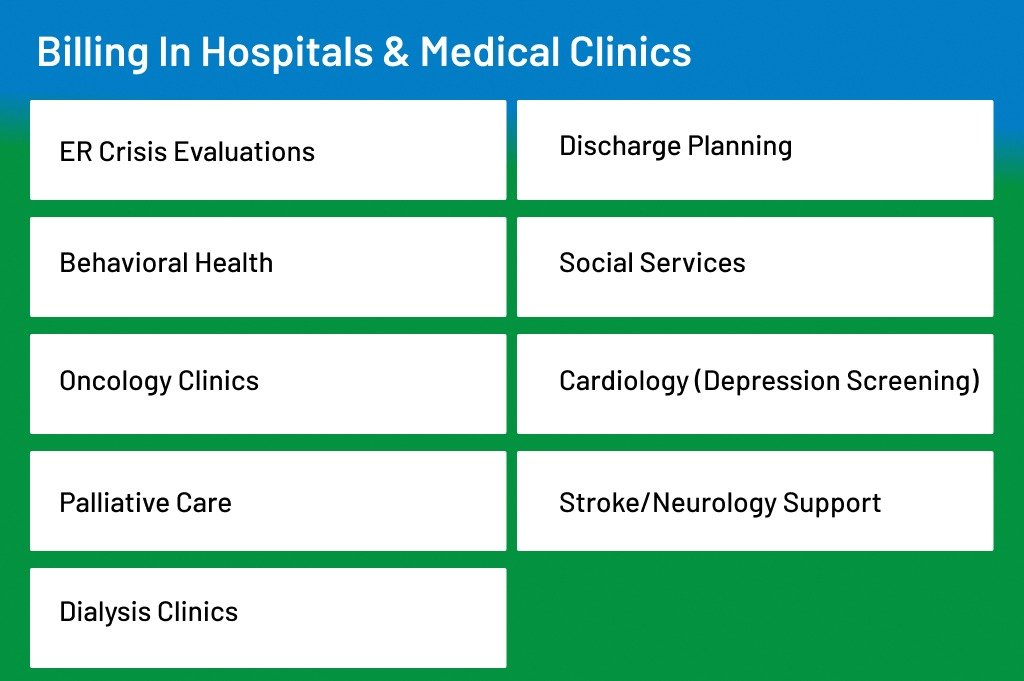
Hospitals LOVE LCSWs.
They hire them for:
- ER crisis evaluations
- Discharge planning
- Behavioral health
- Social services
- Oncology clinics
- Cardiology (depression screening)
- Palliative care
- Stroke/neurology support
- Dialysis clinics
LMFTs?
Hardly ever hired in medical environments.
Why?
Hospitals want clinicians who understand:
- Insurance
- Social systems
- Case management
- Advocacy
- Discharge planning
- Psychosocial assessment
These fall directly under the LCSW domain.
Billing for Couples Therapy (Where LMFTs Shine)
This is LMFT territory.
Insurers often see LMFTs as:
- Specialists in couples therapy
- Specialists in family dynamics
- Experts in relational patterns
LMFTs often earn:
- Higher cash-pay rates
- More referrals for couples
- Better private practice income per session
Couples therapy is one of the highest-paying specializations in all of mental health — and LMFTs own that niche.
Reimbursement Reality: If You Want the Highest Earning Potential
Pick LCSW if you want:
- Higher reimbursement
- More payer types
- Medicare access
- Medicaid coverage
- Hospital + medical work
- Crisis work income
- Government contract opportunities
Pick LMFT if you want:
- Cash-pay couples therapy
- Niche family therapy work
- Private practice only
- Less bureaucracy
- Relationship-focused sessions (often higher fee per session)
Can LMFTs and LCSWs Bill the Same Private-Pay Rates?
Yes.
Private-pay ≠ insurance.
Therapists set their own fee.
Typical cash rates:
- LCSW: $120–$200
- LMFT: $120–$220
- Couples counseling: $160–$300+
- Specialized couples therapy (EFT/Gottman): $220–$350+
LMFTs often charge more privately because:
- Couples therapy isn’t always covered by insurance
- High demand
- High specialization
Which License Is Better for Running a Private Practice?
If we’re talking pure business:
LCSW
- More insurance options
- Broader reimbursement
- Access to medical referrals
- Easier credentialing
- Lower denial rate
LMFT
- Better niche specialization
- Higher cash-pay ceiling
- Strong appeal for couples and families
Overall winner for insurance-based practice: LCSW
Overall winner for cash-pay couples practice: LMFT
Conclusion
At the end of the day, choosing between LCSW and LMFT isn’t about picking the “better” license. It’s about picking the lens you want to use to understand people. If you’re drawn to big-picture issues — the stress, the trauma, the social pressures, the life events that shape mental health — then the LCSW track feels like home. It gives you broad flexibility, more billing doors open, and stronger footing in medical settings.
But if you love digging into relationships, if you’re fascinated by why couples fall into the same argument 300 times, or if you’re the friend everyone calls when family drama explodes — the LMFT path is perfect. You get to specialize early, charge higher private-pay rates, and build a niche practice centered on connection and communication.
Financially, the reality is simple:
- LCSWs tend to have higher and more stable reimbursement options, especially through Medicare and Medicaid.
- LMFTs can out-earn LCSWs in cash-pay couples therapy, especially when trained in specialties like EFT or Gottman.
There’s no wrong answer — just the right fit for your goals, your personality, and the type of work you want to wake up excited about.
And whichever path you choose, the real win is making an impact. People need therapists now more than ever. Whether you zoom out like an LCSW or zoom in like an LMFT, your work shapes lives.
Let ANR Billing Handle the Billing Headaches, So You Don’t Have To
If you’re an LCSW or LMFT building a practice (or leveling up an existing one), billing shouldn’t be the thing slowing you down. That’s where ANR Mental Health Billing steps in.
We help you:
- Get credentialed with the right payers — fast
- Reduce denials for LMFT-restricted plans
- Maximize reimbursement for therapy codes like 90791, 90834, 90837, 90846/90847
- Navigate Medicare/Medicaid rules (especially for LCSWs)
- Set up clean claim workflows that boost collections
- Keep your schedule full while we handle the paperwork
Therapists deserve to focus on clients — not CPT codes, payer rules, and confusing credentialing portals.
If you want smoother billing, higher reimbursement, and fewer headaches, ANR Billing is your behind-the-scenes partner.
Let us take the admin work off your plate so you can focus on what you do best: changing lives.
Reach out to ANR Billing today
